Compulsory Product Certification (3C): listed products cannot leave the factory, be sold, or be imported without a certificate. The core value of our service: accurate catalog determination, documents right the first time, no timeline drag.
Per the SAMR “Compulsory Product Certification Catalog”, common categories include (not exhaustive; latest catalog prevails):

CCC is China's mandatory market-access system. Eligibility is determined by whether the product falls under a catalog description — brand and sales volume don't matter, only product category and technical features.
Smart hardware note: the whole device may not be listed, but its power adapter, lithium battery and other parts may be, requiring separate certification; wireless-enabled devices additionally trigger SRRC requirements.
When unsure, do a catalog comparison first, then choose the submission path — a wrong call doubles the cost and timeline later.
The foundational regulation of CCC: listed products without certification may not leave the factory, be sold, imported, or used in other business activities.
Defines the 17 categories, specific product types and applicable descriptions; the catalog adjusts dynamically — the latest version prevails.
Each product category maps to specific implementation rules and safety / EMC national standards; the rules set test items and factory inspection requirements.
Of the six stages, catalog comparison and pre-testing are the two that decide cost and timeline:
Determine catalog placement and certification units — unit division directly affects cost and is the first money-saving step.
Business license, technical documents, critical component list etc. — application filed with the certification body (e.g. CQC).
Our in-house lab pre-screens electrical safety, temperature rise and EMC; non-conformities get an on-the-spot rectification plan and re-test, cutting rework at formal submission.
Samples to designated labs, tested per the applicable GB standards, with full progress and rectification follow-up.
Initial factory quality-assurance capability check; we coach system documents and production consistency in advance.
CCC certificate obtained (valid 5 years); annual inspection / surveillance reminders delivered after.
Getting documents right the first time saves a round of returns. You only provide raw information and drawings; we handle template filling and checklist preparation.
| Documents | Key Requirements | What We Do |
|---|---|---|
| CCC application form | Official template, stamped with the applicant's official seal | Filled per the current template; the three parties (applicant / manufacturer / factory) are verified |
| Entity qualification documents | Copies of the three parties' business licenses with seals; imported products additionally need authorization proof and agency agreement | Consistency check, avoiding “applicant ≠ producer” rejections |
| Product Technical Documents | Schematics, PCB layouts, spec sheets, critical component list (model / spec / maker / CCC status) | Prepared in lab-required formats, with critical-part certification status marked |
| Labels & manuals | Manuals with safety warnings and procedures; nameplates showing model, parameters, maker and CCC mark placement | We provide nameplate and warning templates, correcting non-compliant marking in advance |
| Sample-related documents | Multi-model difference statements (series products), photos of sample exterior and internals | Difference-table preparation and photo guidance, clarifying series coverage in one pass |
| Declaration of conformity | Committing to conformity with mandatory national standards and truthful application info; signed and sealed by the legal representative | Template provided and verified item by item |
| Documents | When Required | What We Do |
|---|---|---|
| OEM/Contract Manufacturing Agreement | Required for OEM / ODM — clarifying design ownership, quality responsibility and trademark authorization | Agreement key-point checklist provided, avoiding certificate ownership disputes |
| Critical-part certificates | For batteries, adapters, chips already CCC-certified, attach certificate copies | Certificate validity verified; uncertified ones get parallel applications or replacement planning |
| Factory quality system documents | Quality manual, procedures, inspection specs — required before the factory audit | Coached drafting + pre-audit, checking record completeness |
| Exemption certificate | Products meeting exemption conditions | Determining exemption applicability and assisting the CCC-exemption process |
| Others | Testing commission letters, trademark authorization letters etc. per body requirements | Completed per the certification body's current checklist |
Insufficient sample count or wrong condition is the most common lab rejection. Three rough tiers by product complexity:
Bluetooth speakers, earbud charging cases — simple construction with separately approved wireless modules. Charging accessories and fixed-frequency fixtures included.
Routers, cameras, gateways — full safety, EMC and RF testing. The bundled power adapter is submitted together with the samples.
Multi-band multi-mode terminals, automotive T-Boxes, satellite terminals — complex or series products. A representative model serves as the primary test subject; the rest are coverage models.
| Hard requirements | Notes |
|---|---|
| Production-ready state | Fully functional and fully configured, exactly matching the declared technical documents and nameplate parameters; no modification or part removal |
| Complete labeling | Labeled with model, production batch and applicant name; accessories (power/data cables) complete |
| Accessory compliance | Batteries, adapters and other listed accessories must already be CCC-certified; uncertified ones need parallel application or compliant replacements |
| Sample retention note | Some products need reserved test interfaces; after testing, some samples are retained and not returned — confirm counts in advance |
Who owns the certificate and who applies depends on the production model; the order depends on the company's credit rating and the product's risk class. Get this step wrong and everything after is redone.
Applicant, manufacturer and factory are the same entity; self-developed, self-produced, applied in one's own name — the certificate belongs to the applicant. Suited to companies with their own factories and production.
Contract manufacturing, the product carries the manufacturer's trademark. A valid contract manufacturing agreement is required, clarifying design ownership, quality responsibility and trademark authorization. Either the manufacturer or the factory may be the certification applicant.
Design + manufacturing integrated; the product design belongs to the manufacturer (or as agreed).Preferably applied for by the manufacturer; the agreement must state IP ownership and quality-responsibility division, to prevent design disputes from invalidating the certificate.
Conditions: company credit rating B or above, no suspended/revoked/cancelled CCC certificates on record, regular low-risk products.
Process: After type testing passes, the certificate is issued first; within 3 months the on-site factory inspection must be completed; certificates that fail the audit will be suspended.
Conditions: Credit rating C/D, high-risk products (home appliances, toys, vehicle parts etc.), or abnormal certificate records.
Process: After type testing passes, the on-site factory inspection must be passed first; the body issues the certificate after consolidating all materials.No sales before certification。

The audit checks more than documents: inspectors verify on the production line that production consistency — whether mass production and submitted samples share the same design and critical parts.
Common failures cluster around: critical components not matching the declared list, missing routine inspection records, inconsistent labeling. All three can be resolved at the pre-audit stage.
We start audit coaching before submission, preparing system documents and production-line records in parallel so the audit never blocks the last mile to the certificate.
| Stage | Typical time | Notes |
|---|---|---|
| Document formal review | 1–2 weeks | Quick pass with complete, correct documents |
| Product type testing | 3–8 weeks | Simple products 3–4 weeks, complex 6–8 weeks |
| On-site factory inspection | 1–2 weeks | Including scheduling, on-site audit and rectification |
| Final review & issuance | 1–2 weeks | Reviewed after consolidating test and audit reports |
| Total | 2–6 months | Failed tests need rectification and re-testing; timeline extends accordingly |
| Cost Item | Reference Range | Charged by / Notes |
|---|---|---|
| Application fee | ¥500–1,000 per certification unit | Charged by the certification body; one model/spec counts as one unit |
| Type testing fee | ¥3,000–8,000 (simple) ¥10,000–30,000 (complex) | Largest share; by test items and complexity |
| Factory inspection fee | ¥1,500–3,000 per auditor per day | Typically 1–2 auditors for 1–2 days, ¥3,000–6,000 total |
| Certificate fee | ¥500 per certificate | Multiple certification units charged per unit |
| Service Fee | Determined by product type | Document preparation, pre-testing, rectification guidance, audit coaching, end-to-end liaison |
| Post-Certification Care | Annual inspection ¥2,000–5,000 per instance | Annual surveillance; certificate changes/renewals per body standards |
The above are common industry reference ranges; actual costs follow the certification body's current pricing and the product assessment. There is no official “expedited certificate” channel — what can be compressed is only process hand-offs and rework waiting. That's why our pre-testing and rectification live in our own lab.
Taking the China Compulsory Certification certificate issued by CQC as the example, check these five fields first:
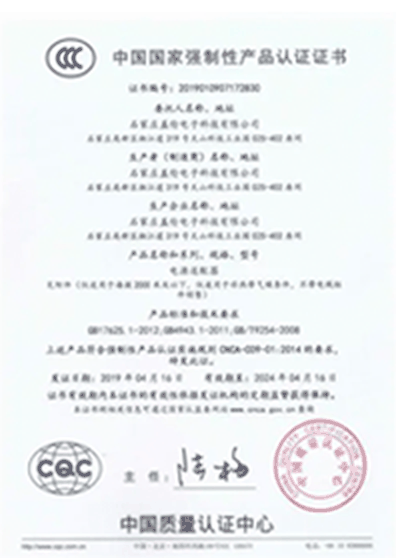 CCC China Compulsory Certification certificate sample (masked) · click to enlarge
A unique number — verify authenticity at the “National Certification & Accreditation Information Public Service Platform cx.cnca.cn”.
Applicant / manufacturer / factory must exactly match the business licenses and OEM agreement — mismatched parties are the most common rejection cause.
Primary test model + coverage models listed together; models sold must fall within coverage.
The applicable implementation rules and GB standards, determining later surveillance frequency and change paths.
Valid 5 years; renew per body requirements before expiry, keeping annual surveillance passing in between.
Tip: certificate information can be verified by certificate number at the “National Certification & Accreditation Information Public Service Platform cx.cnca.cn” — verify authenticity before cooperating.
These are questions real clients have asked; answers follow the current regime — specifics defer to the latest rules and your product's actual situation.