Any product sold in China with radio transmission capability requires type approval. Our core: accurate band & power assessment, one-pass submission.
Products with radio transmission (including receive-and-forward), typically:
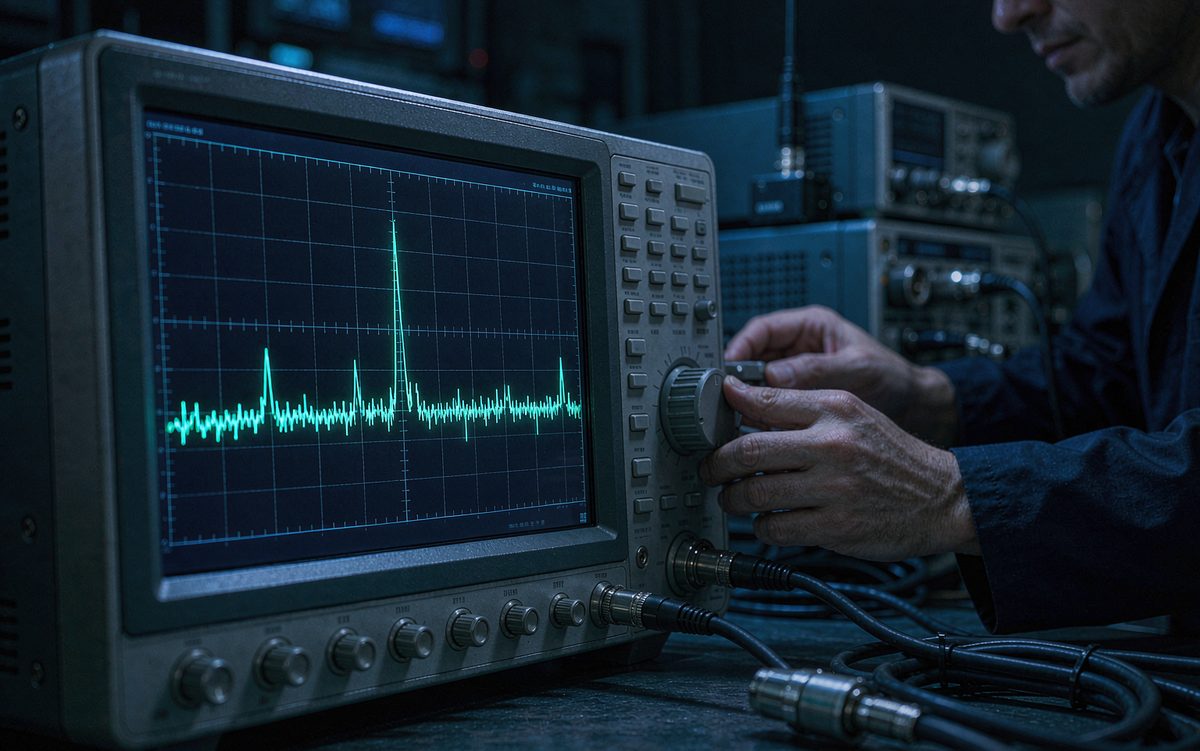
Type approval governs “whether this device uses the spectrum cleanly”: whether the band is compliant, the power within limits, the spurious emissions non-interfering.
The criterion is simple — if the device contains a module that actively transmits radio waves, the whole device needs approval. Using an already-approved module lowers risk but does not exempt the whole-device obligation.
For some telecom terminal products, the SRRC requirement has been folded into the CCC catalog — latest catalog prevails. This is exactly where professional assessment matters.
The upper-level basis of the type approval system: producing or importing radio transmission equipment requires type approval.
Published November 2022, effective July 1, 2023 — covering compliance in production and sales.
Emission limits and technical requirements for 2.4G / Bluetooth low-power bands — the baseline for pre-testing.
Five stages; pre-testing decides whether submission passes first time:
Sort out modules, bands and transmit power; determine the approval path and test items.
Business license, technical documents, frequency/power descriptions — the type approval application is filed.
Full-band pre-scan in our own lab; when spurious, power or frequency offset exceed limits, antenna matching and filter shielding are fixed on site, re-tested, and only then submitted.
RF testing (frequency tolerance, power, spurious etc.), fully followed.
Obtaining the radio equipment type approval certificate; delivery with follow-up change reminders.
Type approval documentation is detailed and template-heavy — one missing item bounces the application. This is our actual delivery checklist.
| Documents | Key Requirements | What We Do |
|---|---|---|
| Type approval application form | Official template, signed by the legal representative with the applicant's seal | Filled on your behalf with model naming rules checked, avoiding model/physical mismatch |
| Type approval commitment letter | Official template, committing to national standards and truthful application info | Template provided with signing guidance |
| Business license copy | Copy with company seal; overseas applicants provide legal entity qualification proof | Entity qualification pre-check |
| Authorization documents | Handler authorization letter + ID copy, specifying scope and validity | Template issued, avoiding authorization expiry |
| Product Technical Documents | Manual, technical handbook, schematics, block diagram, RF critical component list | Prepared per test items; band and power descriptions aligned with measured data |
| Product photos | Six-view exterior, board front/back, nameplate; actual photos with scale bars | Coached on shooting angles and annotation |
| Production capability & QA statement | If already ISO9001-certified etc., a certificate copy suffices | System document review |
| Documents | When Required | What We Do |
|---|---|---|
| OEM/Contract Manufacturing Agreement | OEM production mode, clarifying applicant and producer responsibilities, sealed by both | Agreement key-point notes |
| Multi-antenna device statement | Multi-antenna RF devices need antenna parameters and transmit power configuration stated | Parameter table template provided |
| Fixed-frequency plan & commitment letter | Wi-Fi / Bluetooth devices need a fixed-frequency test plan | Template and setup instructions provided |
| E-label format | Devices displaying CMIIT ID electronically need interface screenshots and setup instructions | Checked against MIIT document Wu [2015] No. 211 |
Complete, functional, production-ready units; of these, 3 units need reserved RF test interfaces for convenient RF port testing.
Samples shipped within 15 business days after application acceptance. Marked with model and applicant; power cords and debugging tools included.
For radar, satellite comms, large automotive and industrial wireless equipment, sample counts and test conditions must be confirmed separately with the testing body.
Tip: testing only needs the RF section accessible — no software changes required. Most rectification issues are power overruns or connection failures — both pre-screened in our own lab.
| Pitfall | Consequence | Our approach |
|---|---|---|
| Using an unapproved wireless module | Whole-device test failure, module rework/replacement | Verify module approval status and CMIIT ID before submission |
| Spurious radiation, power over limit | Test failure; re-test after rectification extends the timeline by weeks | Full-band pre-scan in our own lab; antenna matching and shielding/filtering fixed on site |
| Band / power description not matching reality | Documents returned for supplement | Technical document pre-review; parameters aligned with measurements before filing |
| Non-compliant sample condition | Lab sample rejection | Item-by-item briefing per the lab checklist; test interfaces reserved in advance |
| Missing multi-antenna / fixed-frequency plan | Supplemental filing or special testing | Multi-antenna statement and fixed-frequency plan templates prepared in advance |
| Application Type | Overall Timeline | Notes |
|---|---|---|
| Standard Process | 8–10 weeks | Standard official order, including testing, acceptance, review and issuance — no extra expediting fee |
| Expedited processing | 4–6 weeks | Priority testing and review; expediting fee charged by product band |
| Stage | Reference time | Notes |
|---|---|---|
| Account registration + document submission + lab selection | About 2 weeks | The MIIT account requires the legal representative's ID |
| Lab testing | 2–4 weeks | Including queueing and rectification time |
| MIIT review issues the CMIIT ID | During review | Queryable on the official site; shipping can be arranged at this point |
| Paper certificate issued | 2–3 weeks | Electronic and paper certificates archived together |
| Cost Item | Notes |
|---|---|
| Official Testing Fee | Charged by the statutory testing body, by band, radio standard and test items |
| Service Fee | Including document preparation, pre-testing, rectification guidance, full filing, progress follow-up, certificate liaison |
| Expediting fee | Only incurred when compressing the timeline; determined by band and product complexity |
For a precise quote, provide the product spec sheet (radio standard, bands, functions) — we issue an itemized quote within 1 business day.
Approval certificates are uniformly numbered and issued by the MIIT; check these five fields on receipt:
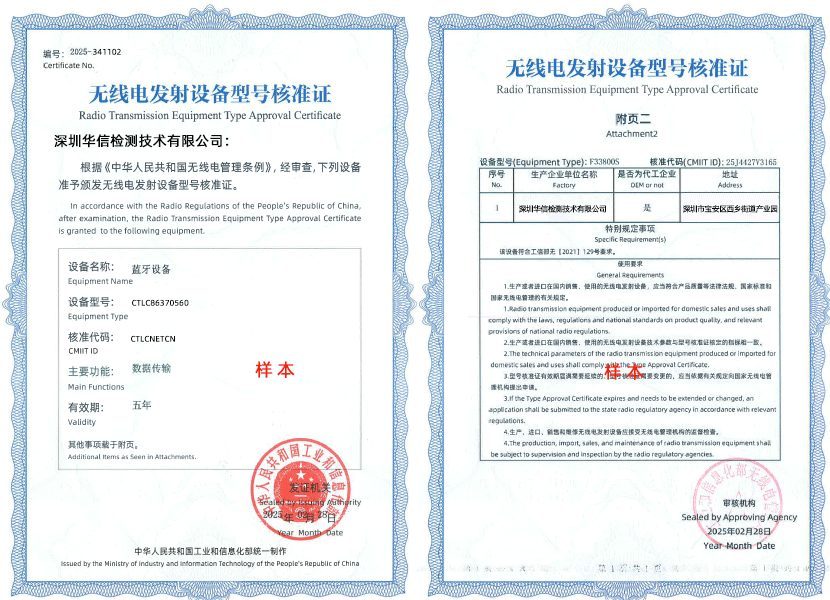 Radio equipment type approval certificate sample · click to enlarge
The approval code must be marked on the nameplate, packaging or electronic display per MIIT Wu [2015] No. 211.
One model, one certificate; multiple trademarks of the same factory and model may share the certificate for shipping.
Band, transmit power, modulation and occupied bandwidth must match measured data — also the comparison items in market spot-checks.
Per band regulations, the legal cap is 5 years; if no new rules apply to the band at expiry, renewal usually needs no testing fee.
Lists the manufacturer, operating conditions and special requirements — the annex is as important as the certificate itself for shipping inspection.
These are questions real clients have asked; answers follow the current regulations — specifics defer to the latest rules and your product's actual situation.